
Drywall Contractor SEO: Turn Patch Jobs Into the Next Room
The patch is the cheapest lead you'll ever get. Here's how drywall shops set up their profile, pages, and tracking so a small repair turns into the basement finish.

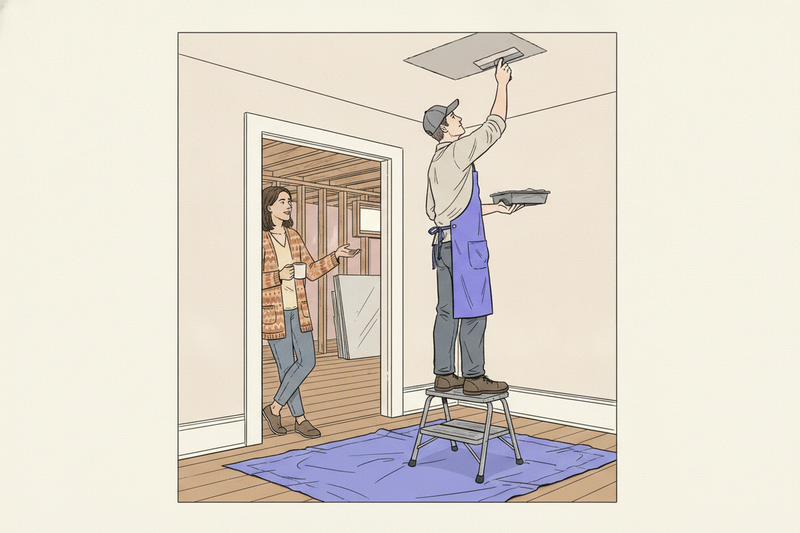
Pull your last 30 drywall invoices and sort them by size. The bottom of the stack is patches: a doorknob hole, a ceiling a plumber cut open, a corner bead somebody's dolly took out. The top is the basement finish and the garage conversion. Now count how many of the big ones came from a homeowner who first called you for a small one. If the answer is more than one or two, that's the case for drywall contractor SEO in a sentence. Win the repair search, then make sure that customer already knows who to call for the next room.
This guide is about that patch-to-project path for drywall shops. If you run a general handyman business and want a full week of small jobs of every kind, the handyman playbook for small jobs is the better read. Here, the small job isn't the business. It's the way in. And if your bigger work means full kitchens, our guide for kitchen remodelers picks up where this one stops.
Key takeaways
- Treat repair searches and project searches as two different jobs with two different pages.
- The patch visit is the sales call. Finish clean, then mention the bigger work once.
- Tag every inquiry by job type so you can see whether patches turn into projects.
- Judge SEO by booked gross profit, not by rankings.
Two kinds of drywall search, two different pages
“Drywall repair” gets about 49,500 searches a month in the US, and “drywall repair near me” another 18,100. “Drywall contractor” gets about 27,100. Those numbers come from Google Keyword Planner data, and they look like one market. They are not.
The repair searcher has a hole and a deadline. A plumber opened the ceiling, a tenant moved out, the house is going on the market. They want to know if you'll take a small job, what the minimum is, and how soon you can come. The project searcher is finishing a basement or adding a room. They want to see whole walls hung, taped, and finished, and they want to know you can work around their schedule.
Give each one its own page. Your repair page should name what you accept: holes, water-stained ceilings, cracked corners, texture matching. State your minimum charge if you have one. Ask for two photos and a ZIP code in the form so you're not driving across town to quote a job outside your range.
Your installation and finishing page should show whole rooms. Name the finish levels you work to, the kinds of projects you take, and how quoting works. Then link the two pages to each other. The repair customer should be one click away from seeing what else you do.
If you cover several towns, service area pages built around real jobs beat a copy-paste page per city. Only build them where you actually work.
The patch visit is your best sales call
No page you publish will sell the basement job as well as the repair visit does. The homeowner watches you lay drop cloths, mask the floor, and match a knockdown ceiling so well they can't find the patch afterward. That's the proof.
Finish the job first. Then mention the larger work once, plainly: “We also hang and finish basements and additions, if that's ever on the list.” Ask whether anything else in the house needs attention. Do not turn a small patch into a sales presentation.
Before you leave, take matching before-and-after photos from the same angle. Those photos do three jobs. They go on your Google Business Profile, on a project page, and in the follow-up text that asks for a review.
Ask every customer for an honest review, not only the happy ones, and don't offer anything in return. Our guide to getting more Google reviews has the wording and timing. A review that says “they matched our ceiling texture perfectly” does more for the next repair search than any keyword you could write.
Three profile fixes that matter for drywall
Most Google Business Profile work is the same for every trade, and our Google Business Profile checklist covers it start to finish. Three parts are specific to drywall.
Category. Set your primary category to Google's drywall contractor category and add secondary categories only for work you do. If you paint, add a painting category. If you don't, leave it off.
Services. List repair and installation as separate services with plain descriptions. A homeowner scanning your profile should see both ceiling repair and basement drywall without clicking anything.
Photos. Texture matching is the skill people doubt most, so show it. Pairs of before-and-after shots from the same angle beat a photo of your truck every time. The GBP photo checklist covers the rest.
If customers don't come to your shop, hide your address and set a service area instead. Listing more towns won't move you closer to anyone. Google ranks local results on relevance, distance, and prominence, and distance is the one you can't edit.
Project pages that show the next room
A gallery lets someone judge your range in ten seconds. A project page tells the story of one job, and it's the page that can show up when someone in that town searches for that kind of work.
Write one for jobs with a real story: the town, the problem, what you did, and the finished photos. “Water-stained ceiling in a 1960s ranch, cut out and replaced, knockdown texture matched to the hallway.” Leave out the customer's name and street.
Then link it to the service page it belongs under. This is the step drywall sites skip: put a repair project and a full-room project side by side. Someone who came in on a patch sees the basement finish two scrolls down.
Do not publish a thin page for every job. Five good project pages beat fifty that say “drywall repair” and a town name and nothing else.
Count the second call
Rankings tell you whether you're visible. They don't tell you whether patches are turning into projects. For that you need two things on every inquiry: where it came from and what kind of job it was.
Track form submissions and calls so each inquiry has a source. The setups are in our guides to form leads in GA4 and call tracking that won't hurt your profile. A click on your call button is not a call. It doesn't prove the phone rang or that anyone asked for work.
Then tag every inquiry by job type: patch, ceiling, installation, finishing, remodel. Do it in whatever you already use, a CRM or a spreadsheet. Once a quarter, check two numbers. How much booked gross profit came from search, and how many repair customers came back for something bigger?
That second number is what this whole approach is built on. A month full of small repairs can look busy and leave little after drive time. A month where three patch customers booked a basement is a different business.
Referrals and paid leads, kept in their lane
Painters, plumbers, and water damage crews all either leave holes or find them. Build a handful of real referral relationships with them and send work back when you can. Track those leads apart from search so you know which source is paying.
Google Ads can fill gaps while your organic visibility grows. Start with exact and phrase match on the services you want to sell, and build a negative keyword list early. Drywall searches pull in plenty of people who will never hire you: “DIY,” “tutorial,” “how to,” “jobs,” “salary,” “wholesale.” Our breakdown of LSAs and Google Ads helps you pick the right paid channel.
Shared-lead platforms that sell drywall leads deserve a fixed trial, not an open-ended commitment. Give one 90 days and count booked-job profit after fees. Keep putting work into your own profile, reviews, and pages during the trial. Those are the assets you keep when you stop paying for leads.
What SEO is worth to a drywall shop
Contractor SEO prices vary because the work varies. More towns, tougher markets, website repairs, and original project content all change the workload. Two quotes with the same monthly number can include very different things.
Get the scope in writing. Know who takes the photos, who asks for reviews, who edits the pages, who sets up tracking, and what the report shows. Keep ownership of your website and your Google Business Profile no matter who runs them. Our guide to vetting a local SEO agency has the questions to ask.
Then do the math against gross profit, not invoice totals. Divide the monthly fee by your average gross profit per extra job. That's how many additional jobs it takes to break even. If a single finished basement covers several months of fees, you only need a few patch customers to come back for it to pay.
Plan on a few months before inquiries move. Google has to crawl and index your changes, and nobody controls the Map Pack, so treat any guaranteed ranking as a red flag. Google's own explanation of how Search works is worth five minutes.
Frequently asked questions
Do I need my license number on my website?
It depends on your state, and sometimes your county. Florida, for example, requires state-certified and registered contractors to put their license number in advertising in any medium, websites included, under section 489.119 of its statutes. Drywall licensing rules differ from state to state and county to county, so check with your state board and county licensing office. Where it's required, it's a compliance step, not a ranking trick.
Should I take subcontract work from general contractors through my website?
Yes, if you want it, but give it its own page. Builders and GCs search differently from homeowners. They want crew size, how far out you're booking, proof of insurance, and the kinds of projects you've finished. A homeowner doesn't care about any of that, so mixing the two on one page makes it worse for both.
Do I need to do anything special to show up in AI search answers?
Not much beyond what's here. Google says there are no extra requirements for its AI features: a page has to be indexed and eligible to show a snippet in regular Search. Keep your services, towns, and project details in plain text on the page rather than inside images, and keep any structured data matching what the page says. Nobody can promise you a mention in an AI answer.
Make the next repair worth more
The cheapest lead you'll ever get is a customer who already let you into their house. Win the repair search, do the work well, and make the bigger jobs impossible to miss on your profile and your site.
Start with the two pages, the three profile fixes, and job-type tagging. Then check the second-call number every quarter.
If you'd rather have someone else run the profile, the reviews, and the pages every week while you run crews, that's the work Curve does.