
Internal Links: The Hidden Reason Your Local Site Doesn't Convert
Most local service sites don't have a traffic problem. They have a path problem. Here's how to fix it with smarter internal links.

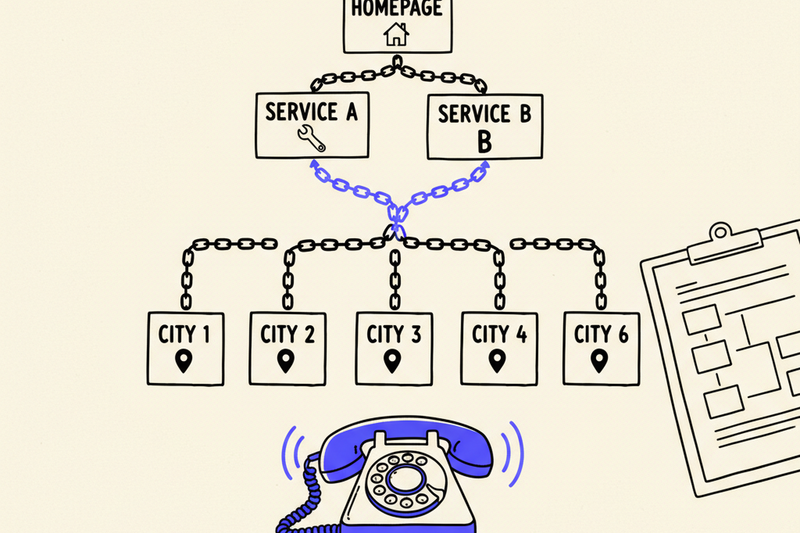
Most local service sites don't have a traffic problem. They have a path problem.
A homeowner lands on your site, looks for the exact service, can't find it fast, and bounces back to Google. The lead didn't disappear because your work was bad. The page path was.
That's why internal linking matters more than most owners think. Done right, it helps Google read your site and it helps real people reach the page that makes them call.
Why internal linking moves the needle in local
Menus aren't a strategy. They're a starting point.
On a local service site, Google has to connect three things fast: what you do, where you do it, and which page deserves to rank for that combination. Internal links spell that out. Your homepage passes context to service pages. Service pages support city pages. City pages point to contact, reviews, and proof. That structure makes the whole site easier to trust.
It matters even more for service-area businesses. A storefront can lean on a strong location page and directions. A mobile crew has to work harder. If you serve 10 towns, your site has to show those relationships clearly.
Internal links also support the Map Pack, even if they don't decide it alone. The profile still does heavy lifting and reviews still matter — but the website backing the profile helps Google trust your business is relevant in the places and services you claim. If you want the broader picture, here's a plain-English look at the factors Google actually weighs.
We see this every quarter after a redesign. A contractor launches a prettier site, but key service pages lose links from the homepage, city pages, and blog. Rankings wobble. Calls dip. In one home services account, tightening internal links was part of a broader cleanup that moved the business from Map Pack #9 to #3 in about 60 days. Calls rose 38%.
Build a call path, not a page pile
A lot of local sites grow like a garage shelf. New page here. Extra city page there. One coupon page from last spring. Nothing talks to anything.
That doesn't work. Your site needs a call path.
Start with your money pages — the services that drive the best jobs and the best margins. Link to them from the homepage, the main navigation when it fits, and related service pages. Then connect those service pages to the cities or neighborhoods where you want stronger visibility.
A clean path usually looks like this:
- Homepage links to core service pages.
- Service pages link to related city pages, FAQs, reviews, and estimate pages.
- City pages link back to the matching service page and forward to contact or booking.
If a person can't reach the right contact page in two clicks, your site's making the sale harder than it should.
Keep the anchor text plain. "Drain cleaning in Mesa" works. "See pricing for pool cleaning" works. You don't need robotic exact-match links everywhere. You need clarity.
Link the pages that build trust and location relevance
Your service pages deserve the most internal links, but they shouldn't work alone.
They need support from pages that answer fear, price, credibility, and logistics — reviews, financing, insurance accepted, before-and-after galleries, FAQs, warranties, and team pages. When those pages link back to the main service page, they help both users and Google see which page is central.
This matters after the click from Maps too. A verified profile isn't a lead source by default. It's a doorway. Once someone lands on your site, the next steps decide whether they call. Pair your structure with a strong Google Business Profile and a steady review flow and the calls compound.
Freshness still counts on the profile side. A weekly or bi-weekly posting rhythm works for most small local businesses. Pair those updates with strong landing pages and real photos. Google Business Profile photos tend to drive clicks when they support a page that's easy to reach, not a dead-end with no next step.
Stop the linking mistakes that muddy local relevance
Most bad internal linking isn't dramatic. It's boring. That's why it slips through.
One common mistake is linking every city page to every other city page in giant blocks. Another is stuffing the footer with 40 towns and 25 services. That doesn't create clarity. It creates noise. A smaller, more intentional structure usually wins.
A second mistake is leaving orphan pages all over the site. You publish a "fence repair in Plano" page, but nothing points to it except the XML sitemap. Google can still find it, but you're not telling it the page matters. That's one of the first cleanup jobs after a slump.
Navigation gets bloated fast, too. Keep the main menu lean, then let content-rich pages do the deeper linking. That's the right call for almost every local business.
Seasonal sites need extra discipline. Seasonal strategies aren't only about fresh offers. They're about moving key pages forward before demand spikes. Pull the pages that matter most closer to the homepage, recent posts, and quote pages before the busy stretch starts.
If calls dropped after a redesign, don't only stare at rankings. Click your own site. See what disappeared. The answer is often sitting one broken path away.
The same framework works across every local niche
The structure shifts a little by business type, but the rule stays the same: your best pages should reinforce the service, the place, and the proof. Whether you're a roofer, a dentist, a med spa, or a wedding venue, link your trust pages back into your service pages and let your money pages get the most love. If you're new to the discipline, here's a primer on how local SEO works for small businesses.
For professional services, the trust layer is heavy. Bios, case results, neighborhood pages, and contact pages should all feed your main money services.
For hands-on home services, visuals and service areas do a lot of the work. Project galleries, seasonal service pages, and city pages should all link into estimate requests.
Different niche, same truth. Internal links are how you turn a stack of pages into a system that points toward a call.
The bottom line
Internal links aren't decoration. They're directions.
When your service pages, city pages, proof pages, and contact pages back each other up, Google gets a cleaner read on your business and visitors get fewer chances to wander off. That's how a local site starts working harder without adding more noise.
Open your site. Click toward your top money service. Count the clicks it takes to reach a real booking page. If the path feels clunky to you, it's costing you calls.