
EV Charger Local SEO: Win More Home-Install Calls
A new EV lands in the garage on Saturday and the search happens Sunday night. Here is how to be one of the three names that shows up, without a second profile.

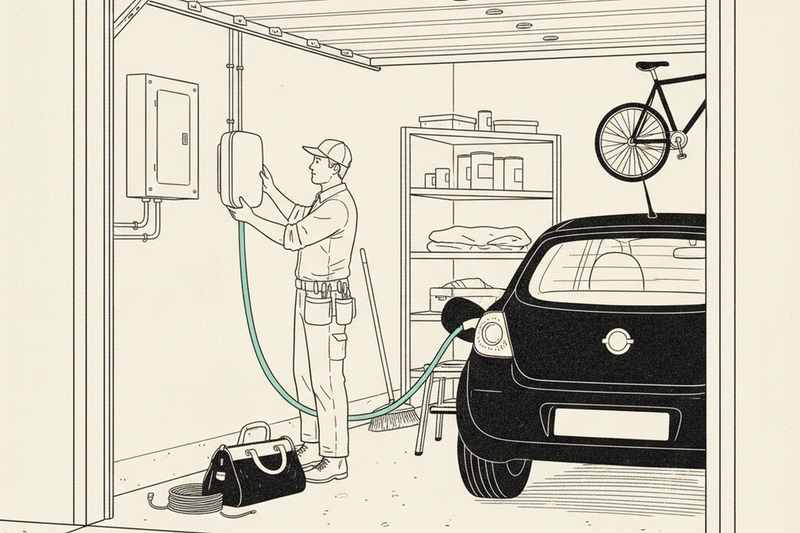
A homeowner takes delivery of an EV on Saturday. By Sunday night they're standing in the garage with a phone, searching "EV charger installation near me."
That call goes to one of the three businesses showing in Google Maps with a clear service list, recent reviews, and a number somebody answers.
Worth being precise about scope here: this is about one high-ticket service line, not electrical work in general. Our guide to local search for electricians covers the broader trade, where the searches are "electrician near me" and the jobs are outlets, fans, and panel work. Charger installs are their own thing, with their own search terms, their own permit questions, and a ticket several times larger. They deserve their own page, their own photos, and their own place in your service list.
What matters most
- Start with the profile and Map Pack visibility, not a blogging schedule.
- Set up an honest service area, pick "Electrician" as the primary category, and put charger work in your service list.
- Build one strong charger installation page with real project photos, permit detail, and a clear next step.
- Keep earning proof: recent reviews, accurate listings, fresh photos, real local relationships.
- Track calls, qualified leads, estimates, booked installs, and revenue.
Start with the Map Pack, not a pile of blog posts
Search "EV charger installation [your city]" and look at the first screen. Google usually shows ads, then a map, then three businesses. Homeowners see ratings, hours, photos, and a tap-to-call button right there.
Your website still matters, but a service page's organic visibility is a separate channel from the map listing. If your Google listing is incomplete or confusing, a 2,000-word article won't save the call.
The job changes what people search
"Electrician near me" is broad. That person might need a ceiling fan replaced.
"Level 2 charger installation in Columbus" is somebody with a car in the garage and a problem that's close to solved. They may also need a load calculation, a 240-volt circuit, a permit, or a panel upgrade.
Treat charger installs as their own money service. Don't bury them under "residential electrical work" and hope Google connects the dots.
Look at whoever is already visible for those searches. Compare their primary category, service list, coverage, reviews, photos, page quality, and how obvious their call button is.
The first goal isn't to rank everywhere. It's to show up where your truck can arrive on time and the job pencils out.
Set up your Google Business Profile the right way
For most residential electricians, this should be a service-area business. You travel to homes. Customers don't come to your warehouse, your home office, or your truck bay.
Google's rules on representing your business are plain: if customers don't visit your address, hide it. Don't turn a mailbox, a virtual office, or a buddy's storefront into a fake location pin. That gets profiles suspended, and a suspension is a headache nobody needs.
Choose a real service area
Google lets service-area businesses add up to 20 cities, ZIP codes, or regions, and its service-area setup instructions say the overall area should stay within about two hours of your base.
Pick the places you truly serve. If you cover Dayton, Kettering, Beavercreek, and Centerville, list those four. Don't add Cleveland because a bigger circle feels better.
A bloated service area doesn't create rankings. It creates long drives, weak relevance, and leads you don't want.
Get the plain details right
Check these every month:
- Your business name should match your truck, your invoices, and your website. Don't append "Best EV Charger Installers."
- A working local phone number that somebody answers.
- Current hours, including holidays and any emergency availability.
- A website link pointing at your charger page, not your homepage.
- Every field Google offers that honestly applies to you.
Google lets you edit contact details, photos, hours, and categories through its profile editing guide. None of it is glamorous. It's still where a lot of calls are won or lost.
Pick a category that matches what you are
A Google category describes what your business *is*, not every service you can perform.
For a licensed electrical contractor doing residential work, "Electrician" is the right primary category. A single service line doesn't describe the company.
Then build out the service list underneath it:
- EV charger installation
- Level 2 charger installation
- Wall connector installation
- Home charging station installation
- Electrical panel upgrade
- Load calculation
- 240-volt outlet installation
Only list work you actually perform. Don't add brand-specific chargers or panel upgrades you can't service.
Your category, services, photos, reviews, and service page should all tell the same story.
Build a charger page that earns the click
Your profile gets the impression. Your page answers the next question: can these people put a charger on my house?
Make one strong page for home charger installation. Don't build fifteen thin pages with the same paragraph swapped from "Akron" to "Canton." Google has seen that movie.
Cover what homeowners ask before calling
A useful page explains what affects the work:
- The charger brand and its amperage
- Garage, driveway, or exterior mounting
- Distance from the electrical panel
- What sits behind the visible charger: panel capacity, circuit routing, conduit, disconnects
- Whether a panel upgrade might be needed
- Permit and inspection requirements in your area
- The difference between a hardwired charger and a NEMA 14-50 outlet
Use real photos from your jobs and explain the process in normal English. Recommend a panel upgrade only when a load calculation or the code actually calls for one. Say whether you install customer-supplied equipment, and whether you help source it.
Put your license details and coverage area near a clear call to action. Make sure the page loads fast on a phone, and keep the number and estimate form easy to tap.
A homeowner doesn't need an engineering lecture. They need to know you won't guess, cut corners, or leave them holding a charger box in the garage.
Give each city a reason to have a page
If you serve several nearby cities, location pages can help, but each one needs real local information.
Mention the neighborhoods, the permit practices, the travel expectations, and the kind of work common in that area. A city page can address older panels, detached garages, condo parking, or outdoor installs when those are genuine local issues.
Your title might be "EV charger installation in Ann Arbor." The copy should sound like somebody who works there wrote it, not a robot with a map. For more on keeping those pages honest, see multi-location local SEO without thin pages.
Show the work, not generic stock photos
Home charging is visual. A clean wall-mounted unit, neat conduit, labeled breaker work: that tells a better story than a paragraph about "quality service."
Add two or three real photos a month to your profile:
- A finished install, with the homeowner's permission
- Your electrician at the panel or the garage wall
- A close-up of clean finished work
- Your truck at a job site
- Before-and-after when the difference is obvious
Blur or crop out house numbers and license plates before uploading. Google's starter guidance encourages photos, service lists, and review replies for exactly this reason.
Skip the staged handshake shots. Nobody searching at 9:30 p.m. is moved by a stock image of two men pointing at a clipboard.
Make reviews part of every finished job
A profile with 12 reviews from two years ago looks abandoned. One with a steady stream of recent, detailed reviews looks like a business that's running.
Ask while the good feeling is fresh
Send the request after the charger works, the site is clean, and the homeowner knows how to use it. Text is fine. Email is fine. Make it easy.
Don't script the review or offer discounts for five stars. Ask for an honest note. A homeowner might naturally mention that you installed the unit before their car arrived, upgraded the panel, or showed up when you said you would. Those details help the next customer.
Reply to every review, good or bad. Keep it short and human.
"Thanks, Mark. Glad we got the charger in before your new car showed up."
That's enough. No keyword salad, no canned "we value your feedback."
Read your reviews for patterns, too: communication, punctuality, workmanship, permits, cleanup. A small shop can do that by eye. Use what you find to fix the service, not to generate scripted reviews.
Deal with bad reviews without making it worse
If a review is fake, abusive, or breaks Google's rules, use the official process to report it. Don't manufacture positive reviews to bury it.
If the complaint is real, reply calmly and offer to sort it out offline. Future customers read your response as closely as the complaint.
Clean up listings before chasing fancy links
Local citations are the directory listings showing your name, phone, website, and sometimes an address or service area. Google isn't impressed by a thousand junk directories. It does care whether your basic details stay consistent where customers look.
Start with the ones homeowners actually see:
- Apple Maps
- Bing Places
- Yelp
- Your local chamber, if it runs a real directory
- Any electrical contractor associations you belong to
Use the same name, number, website, and coverage everywhere. If you moved, changed numbers, or rebranded, hunt down the old listings and fix them. Check for duplicates and wrong addresses while you're in there. A wrong phone number is worse than no listing, because it sends a ready-to-book homeowner somewhere else.
For one to three locations, review the important records monthly or after any major change. Fix the meaningful listings first instead of paying forever for a dashboard full of obscure sites.
Add proof beyond the profile
Your website should confirm what the profile claims. Show your installation capability, panel and load work, the charger types you handle, permits, and real project examples. Put your coverage area and contact details in the footer and on the contact page. Include your license number where it makes sense. Add testimonials from real installs and a short FAQ about permits, panel capacity, outdoor installs, and the brands you work with.
Once a quarter, click through your own site: page titles, internal links, forms, phone links, and any errors on service or city pages.
Use structured data, but don't expect magic
Valid LocalBusiness or Electrician structured data clarifies your business details. It doesn't put you at number one in Google Maps. Anyone promising that is selling smoke.
Ask your web person to add it using your real name, phone, address or service-area setup, hours, website, and social profiles. Google's LocalBusiness structured data documentation covers the supported fields and how to test it.
Keep it consistent with your profile. Schema isn't a place to invent five locations, claim services you don't offer, or add fake ratings.
Build local links the old-fashioned way
Real relationships first: builders, solar companies, neighborhood groups, regional EV clubs, trade associations.
Sponsor something legitimate. Join something. Teach a short charger-safety session at a community event. Partner with a solar installer or a home builder when the work genuinely fits.
The point isn't collecting links like baseball cards. Real participation gives your name a legitimate local footprint, and paid placements don't.
Track calls and booked jobs, not vanity rankings
Rankings shift by neighborhood, device, and search context. A search from your office looks different from one five miles away. That's why "we're number one" isn't a report.
Measure map visibility separately from organic rankings, and focus on the areas you actually serve.
Watch the numbers that pay your bills
Each month, look at:
- Calls from your profile. Attribution isn't perfect, but the trend is real.
- Qualified leads. Separate genuine opportunities from tire-kickers.
- Estimates requested. The step between interest and revenue.
- Charger jobs booked. Whether the service line is paying for itself.
- Revenue from those jobs. The only number that settles the argument.
- New reviews. Trust, and a profile that looks alive.
- Map visibility in your target neighborhoods. Where you're gaining or slipping.
Use call tracking carefully. A dedicated number helps, but keep your primary business number consistent everywhere it matters. Add UTM tags to the website link on your profile so that traffic is easy to identify.
Checking visibility from several points across your target neighborhoods beats a single office-based rank report. A rank report can't pay for a panel upgrade. A booked install can.
Keep a weekly cadence instead of chasing tricks
One big profile cleanup is a good start. It isn't a plan.
Local search moves when the basics stay current: fresh reviews, new job photos, accurate hours, answered questions, fixed listings, and pages that reflect the work you want more of.
A simple monthly rhythm
- Add fresh photos from completed installs.
- Send review requests after every finished job.
- Reply to new reviews within a few days.
- Check services, hours, and coverage for changes.
- Review calls, forms, and booked work from Google.
- Add one useful FAQ, project note, or local detail to your charger page.
You don't need daily posts or a new article every Tuesday. Post real project updates, seasonal notes, safety guidance, or availability changes.
This is where most of it falls apart. A business does one cleanup, gets busy, then leaves the profile, reviews, listings, and pages alone for six months. Meanwhile the competitor with follow-through looks more credible, because homeowners keep seeing fresh proof.
Give each real location its own plan
If you run more than one branch, each needs its own profile, page, reviews, photos, hours, and service area. Don't clone one profile and change the city name.
Google allows separate profiles for distinct, eligible operating locations, and each one must represent a real place, not a virtual pin.
A branch handling suburban charger installs should feature that work in its page, photos, and lead tracking. A branch focused on commercial electrical needs its own service list, page, and reporting.
If this sounds like a lot, it is. It's also where consistency earns its keep, and it's the ongoing work Curve handles for service businesses that would rather be in the truck.
Common questions
What is EV charger local SEO?
The work of helping electricians show up when nearby homeowners search for charger installation: an accurate Google Business Profile, a real service page, reviews, photos, clean listings, and lead tracking.
Should I create a separate profile for charger installs?
No. Your primary category should describe what the business is, usually "Electrician." Add charger installation and related work to the service list instead.
Do I need a page for every city I serve?
Only when each page carries real local value: genuine coverage details, permit information, common property types, and relevant project examples. Copying a page and changing the city name doesn't count.
How do I get more reviews for these jobs?
Ask after the charger works, the site is clean, and the homeowner understands it. Make the request easy, ask for honesty, never offer incentives, and reply to every review.
What should I track?
Profile calls, qualified leads, estimates, booked installs, revenue, new reviews, and map visibility in your target neighborhoods. Rankings are context. Booked work is the score.
The call starts before your phone rings
Residential charger work is local, practical, and high intent. Homeowners want a qualified electrician nearby who looks credible, answers the phone, and understands the job.
Own the neighborhoods you can serve reliably. Keep showing proof, answer promptly, and follow through on every lead.